What Your Tongue Already Knows: The Chemistry of a Truly Smooth Vodka
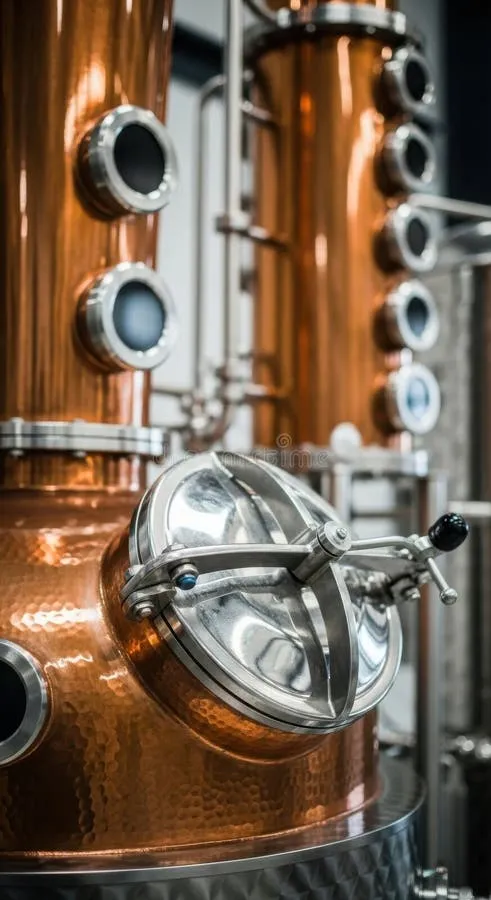
Photo: close up vodka distillation copper still laboratory craft spirits, via thumbs.dreamstime.com
There is a moment — familiar to anyone who has compared a well-crafted vodka against a bargain-shelf alternative — when the difference between the two becomes undeniable. One settles onto the palate with a kind of quiet authority. The other announces itself with heat, a ragged edge, and a finish that lingers in the wrong way. Your instincts are not deceiving you. What you are detecting is chemistry, and understanding it transforms you from a casual consumer into a genuinely discerning one.
At Ten Forward Vodka, we believe that knowledge and pleasure are not mutually exclusive. The more you understand what separates a craft spirit from a mass-produced one, the more fully you can appreciate what is in your glass.
The Congener Question: What Distillers Are Really Removing
Vodka, by federal definition, must be a neutral spirit — colorless, odorless, and tasteless to the greatest practical extent. But the practical extent varies enormously between producers, and that variation lives in a class of chemical compounds called congeners.
Congeners are byproducts of fermentation: fusel alcohols, aldehydes, esters, and organic acids that emerge alongside the ethanol your yeast produces. Some congeners, in trace quantities, contribute desirable complexity. Others — particularly higher-chain fusel alcohols like isoamyl alcohol — are responsible for the harsh, solvent-like burn that defines low-quality spirits and, the morning after, contributes to the headache you would rather not recall.
Mass-produced vodkas often undergo rapid, high-volume distillation that leaves more of these compounds in the final product. Craft distillers, by contrast, tend to run slower, more deliberate distillation cycles, and they are far more attentive to what distillers call the cut — the precise moment at which the distillate transitions from the desirable "heart" to the harsher "tails." Getting that cut right is as much art as science, and it is one of the clearest dividing lines between a commodity spirit and a craft one.
Distillation: More Passes, More Precision
You have likely seen vodkas marketed with the phrase "distilled five times" or even "distilled seven times." The implication is that more distillation equals greater purity, and while that is broadly true, the relationship is more nuanced than the label suggests.
Each pass through a pot still or column still removes additional impurities and concentrates the ethanol. However, distilling an already-clean spirit repeatedly through a standard column offers diminishing returns after a certain point. What matters more is the design of the still, the proof at which distillation occurs, and the skill of the distiller in managing temperature and flow rate throughout the run.
Craft distilleries frequently invest in copper pot stills or hybrid systems that interact with the distillate in chemically meaningful ways — copper, for instance, binds to sulfur compounds that would otherwise produce off-flavors. The result is a spirit whose smoothness is a product of genuine craft, not simply a higher number on a marketing sheet.
The Role of Water: Mineral Content and Mouthfeel
Once a vodka reaches its target proof — typically 80 proof, or 40% ABV, for retail — it must be diluted with water. The water used in this final step is not incidental. It is, in many ways, the final ingredient.
Water chemistry varies dramatically by region. Hard water, rich in calcium and magnesium, can lend a certain weight or texture to the spirit. Exceptionally soft water — the kind drawn from glacial aquifers or limestone-filtered springs — tends to produce a cleaner, silkier mouthfeel. Many of the world's most celebrated vodkas draw deliberate attention to their water sources, and for good reason: the mineral profile of the dilution water directly affects how the ethanol interacts with your taste receptors.
In the United States, craft distillers from the Cascade Mountains to the Appalachian foothills are increasingly treating their local water sources as a point of distinction — a form of terroir that connects the spirit to its place of origin in a way that mass producers, drawing from municipal supplies or reverse-osmosis systems, simply cannot replicate.
Filtration: A Tool, Not a Substitute for Quality
Activated charcoal filtration — the method made famous by certain large-scale producers — works by adsorbing impurities onto the surface of carbon particles as the spirit passes through. It is an effective technique, and it can meaningfully improve the character of an otherwise rough distillate. However, filtration cannot compensate for poor distillation, and over-filtration can strip a spirit of the subtle characteristics that make it interesting.
Craft producers often employ gentler filtration methods — quartz sand, cellulose filters, or even single-pass charcoal systems — that clean the spirit without homogenizing it. Some choose not to filter at all, relying instead on the quality of their distillation to deliver a product that needs no remediation.
The distinction matters. A heavily filtered mass-market vodka and a carefully distilled craft vodka may both present as "smooth" in a casual tasting, but they arrive at that smoothness through fundamentally different means. The former has had character removed. The latter was built to have the right character from the start.
Training Your Palate: A Practical Framework
Developing the ability to detect these differences is less daunting than it sounds, and the practice itself is its own reward. Here is a framework for approaching a vodka tasting with genuine intention:
Neat, room temperature first. Pour a small measure — no more than half an ounce — and allow it to rest for two minutes. Cold temperatures suppress aromatics and numb the palate. You want to taste the spirit as it is.
Assess the nose. Lower your glass to just below your nostrils and inhale gently. A high-quality vodka may offer faint notes of grain, cream, or even a subtle floral quality. Harsh ethanol on the nose is a reliable indicator of congener load.
Observe the entry. The first moment of contact with the tip of your tongue will tell you about sweetness and texture. Does the spirit feel viscous and round, or thin and sharp?
Follow the midpalate. As the spirit moves across your tongue, note whether it expands or contracts. A well-made vodka tends to bloom — it opens up rather than retreating into heat.
Evaluate the finish. The finish should be clean, warm, and relatively brief. A finish that burns, lingers harshly, or leaves a chemical aftertaste points to fusel alcohol presence.
With practice, these distinctions become second nature. More importantly, they become the foundation of a vocabulary — one that allows you to communicate precisely about what you are tasting and to seek out the spirits that genuinely meet your standard.
The Discerning Glass
At Ten Forward Vodka, smoothness is not a marketing promise. It is a technical commitment, one that runs through every decision we make — from the grain we select to the water we use to the patience we bring to every distillation run. Understanding the science behind that commitment does not diminish the pleasure of a well-made cocktail. It deepens it.
Because the most satisfying sip is always the one you have earned the right to fully appreciate.