The Art of Disappearing: How Craft Vodka's Neutrality Becomes a Bartender's Most Powerful Tool
The most sophisticated thing a spirit can do, in certain company, is stay quiet.
This is the paradox at the center of professional mixology's renewed interest in craft vodka. For decades, the spirit was treated as a vehicle for volume—a neutral carrier that made cocktails potable without meaningfully shaping them. The bartender's relationship with vodka was functional, transactional, and not particularly interesting. Then something changed. A generation of American bartenders, trained in the discipline of ingredient sourcing and flavor architecture, began to look at vodka's neutrality not as a deficiency but as a design opportunity.
The result is a quieter, more considered approach to cocktail construction—one in which the spirit's willingness to disappear becomes, paradoxically, its defining contribution.
Subtraction as a Creative Philosophy
Modern cocktail design, particularly at the level of serious craft bars, has increasingly embraced what might be called the philosophy of subtraction. Rather than layering flavor upon flavor in pursuit of complexity, practitioners of this approach ask a different question: what happens when you remove the noise and let a single element speak at full volume?
Craft vodka, precisely because it carries minimal intrinsic flavor, is uniquely suited to this methodology. When a bartender reaches for a premium grain-based vodka with a clean, textured finish, they are not choosing a background player. They are choosing a frame—a structure that holds the composition without competing with it.
"The vodka is doing the structural work," says one cocktail program director at a well-regarded Chicago bar that has built its reputation on hyper-seasonal menus. "If I want a drink to taste like a specific ingredient—a particular variety of apple, a foraged herb, a single-origin honey—I need a spirit that won't argue with me. Craft vodka, when it's made well, has the discipline to stay in its lane."
This framing recontextualizes what smoothness means in a professional setting. A premium craft vodka is not smooth because it has been stripped of character. It is smooth because its character has been refined to a point of elegant restraint—present enough to provide structure, quiet enough to serve the larger composition.
House-Made Syrups and the Precision of Sweetness
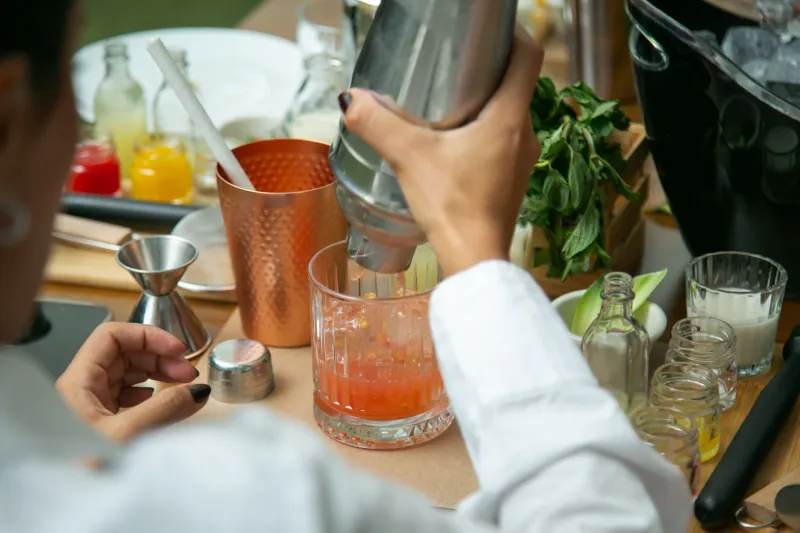
One of the clearest expressions of this philosophy appears in how craft bars approach sweetness. The era of commercial grenadine and pre-packaged sour mix has given way, in serious establishments, to a culture of in-house production that treats syrups and shrubs as culinary ingredients worthy of the same care as any other kitchen preparation.
When a bartender crafts a lavender-honey syrup from locally sourced ingredients, or a spiced demerara reduction built around a specific chili variety, they are investing considerable effort in a single flavor note. The spirit carrying that note must not obscure it. Craft vodka's clean profile ensures that the syrup's work is not undermined—every aromatic compound in that preparation arrives in the glass intact, without interference.
The same logic applies to shrubs—the vinegar-based drinking syrups that have become a fixture of the craft cocktail pantry. The interplay between acid, fruit, and sugar in a well-made shrub is delicate and easily overwhelmed by a spirit with assertive character. In a vodka-based cocktail, that interplay is preserved with a fidelity that other base spirits often cannot match.
Rare Bitters and the Architecture of Bitterness
The American craft bitters revival has produced an extraordinary range of flavor profiles—from traditional Angostura-adjacent expressions to genuinely unusual preparations built around ingredients like black walnut, gentian, and smoked paprika. These are products of considerable craft, and they deserve to be heard.
In a cocktail built on a spirit with pronounced flavor—a heavily peated Scotch, an aged rum with significant barrel influence—bitters function as seasoning, a finishing touch that modulates an already complex profile. In a craft vodka cocktail, they become something closer to a lead voice.
"I use bitters differently in vodka drinks than I do in anything else," explains a bar program consultant who works with independent craft cocktail bars across the Pacific Northwest. "With a big spirit, bitters are punctuation. With vodka, they're the sentence. You can use three or four dashes of something genuinely unusual and the drinker will actually taste it. That's not always possible with other spirits."
This dynamic has encouraged some of the more adventurous bartenders in the country to treat craft vodka cocktails as a dedicated showcase for bitters exploration—a way of educating guests about the range of botanical flavors available in a format that makes those flavors maximally legible.
Unexpected Infusions and the Limits of Convention
The craft cocktail movement's fascination with infusion has found a particularly receptive partner in vodka. Because the spirit does not impose its own flavor story, infused craft vodkas—whether produced at the distillery level or in-house by the bar program—offer a degree of flavor precision that infused versions of more characterful spirits cannot always achieve.
Bartenders at the forefront of this practice have moved well beyond the familiar territory of citrus and berry. Current explorations include koji-fermented grain infusions that add umami depth to otherwise clean expressions, cold-brew coffee infusions calibrated to specific roast profiles, and vegetable-forward preparations—roasted beet, charred corn, heirloom tomato—that challenge conventional assumptions about what a vodka cocktail can taste like.
The common thread is intentionality. These are not novelty infusions designed to surprise. They are deliberate flavor decisions made possible by a base spirit disciplined enough to carry them without distortion.
The Bartender as Editor
What emerges from conversations with practitioners across the American craft cocktail landscape is a consistent metaphor: the bartender working with craft vodka is functioning less as a composer and more as an editor. The ingredients provide the content. The spirit provides the clarity.
This is a meaningful reframing of vodka's role in the professional bar environment. It asks more of the other ingredients, demands greater precision in sourcing and preparation, and rewards the drinker with a glass that is, in the best possible sense, transparent—not because nothing is happening, but because everything that is happening can be seen.
In this light, craft vodka's neutrality is not a limitation to be worked around. It is the condition that makes a certain kind of excellence possible.