The Artisan's Pantry: A Thoughtful Guide to Botanical Vodka Infusions at Home
The relationship between a craft vodka and the botanicals one might introduce to it is not unlike the relationship between a fine canvas and the painter who chooses to work upon it. The canvas matters. Its texture, its weight, its particular quality of white—all of these inform what the paint will do, how it will sit, how it will be perceived. A mediocre canvas does not ruin a painting, but it limits it. A superior one opens possibilities.
This is why, when home enthusiasts begin exploring botanical infusions, the single most consequential decision they will make is the choice of base spirit. Infusion is not a technique for disguising a neutral or unremarkable vodka. It is a method of conversation—and the most interesting conversations require two engaged parties.
Understanding the Canvas: Why Base Spirit Quality Defines the Outcome
Mass-produced vodkas engineered for absolute neutrality present a particular challenge for infusion work. Because they have been stripped of nearly all character through aggressive filtration, they offer the botanicals little to interact with. The resulting infusion tends to be one-dimensional: the flavor of the additive, sitting atop an alcoholic blank. The spirit contributes nothing of its own.
A premium craft vodka, by contrast, arrives with its own subtle vocabulary—a faint grain sweetness, perhaps, or a gentle mineral quality derived from the water source, or the particular mouthfeel that comes from small-batch distillation and measured filtration. These existing characteristics do not compete with botanical additions; they collaborate with them. A citrus peel infused into a wheat-based craft vodka with natural cereal notes will produce something qualitatively different from the same peel in a potato-based expression with its characteristic weight and earth. Both are valid. Neither is predictable. That unpredictability is where the artisan's work begins.
The Seasonal Pantry: Choosing Your Botanicals with Intention
The most rewarding infusions are those built around what is genuinely available and excellent at a particular moment in the year. Seasonal thinking is not merely aesthetic; it is practical. Ingredients at peak freshness carry more aromatic oil, more vibrancy, and more complexity than their out-of-season counterparts—and those qualities transfer directly into the infused spirit.
Spring and Early Summer offer an abundance of bright, delicate botanicals: fresh cucumber, young mint, elderflower, and lemon verbena. These ingredients are volatile and require shorter steeping times—typically 24 to 48 hours—to avoid bitterness or the loss of their most delicate notes. A spring infusion built around thinly sliced cucumber, a few sprigs of fresh dill, and a wide strip of Meyer lemon peel produces a spirit of remarkable freshness that is equally compelling neat or as the foundation of a minimal cocktail.
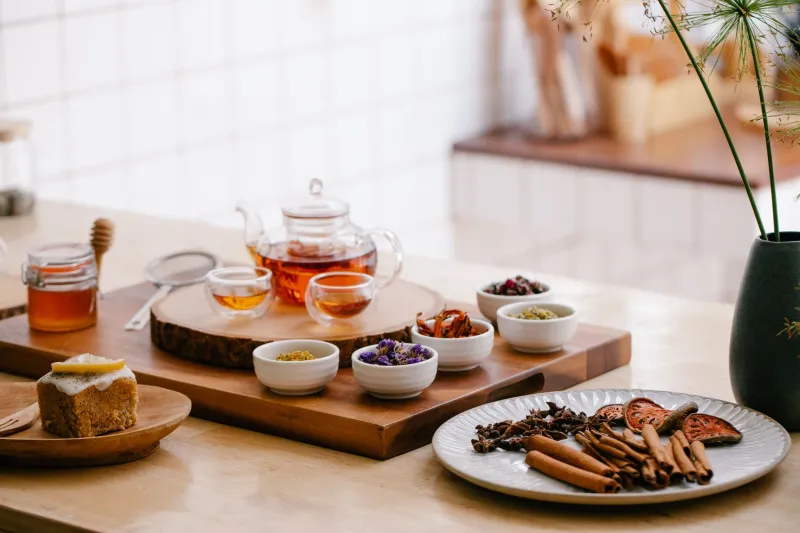
Late Summer and Autumn shift the palette toward warmth and depth. Stone fruits—ripe peaches, plums, apricots—carry natural sugars that interact with the spirit's alcohol in interesting ways, softening the perception of heat and adding a rounded, almost syrupy quality to the mouthfeel. Warming spices—whole cardamom pods, cinnamon sticks, a single star anise—belong to this season as well, though they demand caution. Spice infusions can move from nuanced to overwhelming in a matter of hours, and the difference between a thoughtfully spiced vodka and one that tastes of mulled wine extract is measured in careful, frequent tasting.
Winter invites the pantry's preserved and dried ingredients: citrus peels (dried or fresh), whole vanilla beans, black peppercorns, dried hibiscus, and roasted coffee beans. These are robust botanicals that can sustain longer steeping periods—three to five days in most cases—without degrading. A winter infusion built around blood orange peel, a split vanilla bean, and a small piece of cinnamon bark produces something that sits comfortably between a digestif and a contemplative neat pour.
Technique: The Variables That Determine Success
Beyond ingredient selection, three variables govern the quality of a botanical infusion: vessel, ratio, and time.
Vessel should be glass—specifically, a clean mason jar or a swing-top bottle with a capacity of at least 750 milliliters. Avoid plastic, which can impart off-flavors, and reactive metals. Wide-mouth jars are preferable because they allow easy access for tasting and adjustment.
Ratio is the variable most frequently underestimated by beginners. The instinct is to add generously—a fistful of herbs, a half-dozen spices. Restraint produces superior results. As a starting framework, consider a single prominent botanical supported by no more than two complementary additions. For fresh ingredients, begin with roughly one cup of loosely packed material per 750-milliliter bottle. For dried spices, a tablespoon is often sufficient.
Time is where attentiveness becomes the essential skill. Every botanical behaves differently in alcohol, and the steeping times suggested in recipes are starting points rather than instructions. The only reliable method is tasting every twelve hours and making notes. When the infusion reaches a point that pleases you—when the base spirit and the botanical additions are in genuine conversation rather than one overwhelming the other—it is time to strain and bottle.
Straining should be thorough: a fine-mesh sieve followed by cheesecloth or a coffee filter removes particulate matter that would otherwise continue to affect flavor in the bottle. Store finished infusions in a cool, dark location, and consume within three to four weeks for peak character.
Infusion as Education
There is a dimension to home infusion work that extends beyond the practical. The process of selecting a base spirit, choosing botanicals with intention, monitoring the transformation over days, and tasting the result with genuine attention is among the most direct paths to understanding what a craft vodka actually is—and what it contributes to everything poured into the same glass.
Distillers who have spent years refining a spirit's character through choice of raw material, yeast selection, distillation technique, and filtration are, in their own way, engaged in a form of botanical conversation that the home infuser is simply continuing. Recognizing that continuity—understanding that the craft spirit you begin with is itself the product of someone's careful, iterative work—transforms infusion from a kitchen experiment into something that deserves the same seriousness one would bring to any artisan practice.
At Ten Forward Vodka, we believe that the most engaged drinkers are those who understand the spirit in their glass from the ground up. There is no faster route to that understanding than getting your hands involved in the process.